This is the problem that lies at the bottom of all efficiency/effectiveness models, all product design, all product testing.
To know the Nepal and Bhutan Tour Cost Breakdown is to know that there is no cost that is unique. There’s a whole range of costs - because it varies on what mode of transport is chosen, where you go to sleep, how long you are away for and the kind of activities you prefer doing. All in all, you could spend say around 3,000 USD on a 12-day trip to Bhutan & Nepal inclusive of a basic tour to Bhutan with the Bhutan package, and roughing it out in Nepal if you are the budget conscious type traveling by yourself. However, two people opting for top-notch accommodation in Kathmandu, a high-end resort in Punakha, flying to watch sunrise on Everest and other exotic experiences can effortlessly spend $30,000.
Most tourists who travel overseas only end up somewhere in the middle between the two extremes. And it is this middle, which is possible to go home having achieved real value, that this guide will take most attention. We will get into the specifics of each cost factor associated with the trip, show Bhutan’s absence and selective structuring of this cost as well as the realities one can buy in the two countries in question with a given number of budgeted dollars.
Before going into numerical detail, there is a need to understand why two adjacent countries have quite at variance approach to foreign travelers. It is not that one is exorbitant and the other inexpensive – the approach towards tourism is different in both the countries.
Nepal’s tourism is free and competitive. There are hundreds of guesthouses, lodges, trekking agencies, and restaurants in the market at every budget range seeking your money. It is not only possible to travel on one’s own – it is far easier to do so. You could land in Kathmandu complete with your backpack with no prior bookings and still have nothing to worry about.
The Kingdom in Himalaya is the complete opposite. Traveling to Bhutan and Bhutanese traveling abroad is strictly regulated by the authorities. Every foreigner who intends to enter the country must engage the services of a duly authorized local travel agent. Furthermore, all the services - accommodation, transport and guiding – are available only in package forms, and not as individual services. Besides this, there is a law, which states that every night a tourist spends in Bhutan he needs to pay a certain tax, which is quite significant. Hence, there is no way one can do cheaper tourism than in this South Asian nation.
Knowing this beforehand helps a lot. When people get offers from the agencies and they start rounding things up, there is no wonder. It is more than that ‘Competition’ or ‘Market prices’ everyone knows about the hotels in these two states. It is the co-existence of two food chain markets in tourism and travel industries.
Most travelers from the US or Europe connect through Doha, Dubai, Delhi, or Singapore to reach Kathmandu's Tribhuvan International Airport. Direct flights from North America don't exist, so factor in one layover minimum.
Round-trip airfare from the United States typically runs:
Economy (booked 3–4 months ahead): $700–1,100 USD
Economy (last-minute or peak season): $1,100–1,500 USD
Business class: $3,500–7,000+ USD
Booking well in advance from major hub cities tends to yield the best fares. Flexibility on travel dates by even a few days can save $150–300 on the round trip.
Nepal's visa on arrival is one of the simplest in Asia:
15-day visa: $30 USD
30-day visa: $50 USD
90-day visa: $125 USD
For a combined Nepal-Bhutan trip where you spend 5–6 days in Nepal, the 15-day visa covers most travelers comfortably. Choose the 30-day if you're extending with a trek or additional regional travel.
Nepal's accommodation range is genuinely one of the widest in Asia — and that's one of the country's great travel advantages.
Budget guesthouses (Thamel, Kathmandu): $10–25 per night
Mid-range hotels (3-star, Kathmandu or Pokhara): $40–90 per night
Upper mid-range and boutique properties: $90–180 per night
Luxury (Dwarika's Hotel, Gokarna Forest Resort, Hyatt Regency Kathmandu): $200–550+ per night
Outside Kathmandu, prices drop noticeably. Pokhara's lakeside hotels offer excellent quality at $30–70 per night. On trekking trails, teahouse accommodation runs $5–15 per night — basic but functional, and part of the experience.
Nepal is extraordinarily affordable for food, and the quality far exceeds what the prices suggest.
Dal bhat at a local restaurant: $3–6 USD
Mid-range restaurant meal (Kathmandu or Pokhara): $8–15 USD
Western food or rooftop dining in Thamel: $12–22 USD
Fine dining or special occasion restaurant: $30–55 per person
Most mid-range travelers comfortably budget $20–30 per day on food, with occasional splurges factored in.
Kathmandu airport taxi (fixed rate): $5–8 USD
Kathmandu to Pokhara flight: $80–130 USD one way
Kathmandu to Pokhara tourist bus: $10–15 USD
Private car hire for full day sightseeing: $45–75 USD
Local taxi per ride (Kathmandu): $2–6 USD
If trekking is part of your Nepal plan — and it should be — here are the permit costs:
TIMS (Trekkers' Information Management System) card: $20 USD
Annapurna Conservation Area Permit (ACAP): $30 USD
Sagarmatha National Park (Everest region): $30 USD
Local trekking guide: $25–45 per day
Porter: $15–25 per day
Teahouse meals on trail: $15–25 per day (three meals)
A 7-day Annapurna Base Camp trek with guide, accommodation, and trail food typically runs $500–800 USD total, permits included.
Backpacker: $35–55 per day
Mid-range: $70–120 per day
Comfort traveler: $130–220 per day
Luxury: $280–600+ per day
No aspect of Bhutan travel planning generates more confusion than the Sustainable Development Fee, and it deserves a clear, direct explanation before anything else.
As of late 2023, Bhutan charges a mandatory SDF of $100 USD per person per night for most international visitors. This is a Royal Government of Bhutan fee — non-optional, non-negotiable, and always listed separately from your accommodation and package costs.
For a 7-night Bhutan stay, that's $700 USD per person in SDF alone. For a couple, $1,400 before a single hotel booking is made.
Indian, Bangladeshi, and Maldivian nationals pay a reduced rate of approximately $15 USD per night.
The Bhutan daily tariff used to be a bundled $250/day minimum package covering accommodation, meals, guide, and transport. The 2023 reform separated the SDF from the service package, giving travelers more flexibility in choosing accommodation — while keeping the conservation fee mandatory. Some travelers see this as a positive change; others find the unbundled structure initially confusing when reading quotes.
The full cost of the Bhutan's visa is in the region of 40 dollars and is handled completely by the authorized tour operator who have been chosen for the purpose. All applications are handled by the respective operator and hence there is no processing of independent applications. Once submitted, the relevant clearance letter is issued to the operator and the actual visa stamp is issued on arrival at the Paro airport. In any case the visa fee includes nor is the SDF combined with the visa fees.
Bhutan's accommodation market has expanded meaningfully in recent years, with genuine options across multiple tiers — though prices remain higher than Nepal at every level.
Local guesthouses and budget properties: $50–90 per night
Mid-range hotels (3-star, Thimphu or Paro): $100–200 per night
Boutique and heritage properties: $200–400 per night
Ultra-luxury (Amankora, Six Senses Thimphu, COMO Uma Paro): $600–1,800+ per night
Bhutan's luxury tier is genuinely world-class. Properties like Amankora — with its five lodges across different Bhutanese valleys — are considered among the finest resort experiences in Asia and attract a discerning international clientele willing to invest in something truly exceptional.
Most Bhutan package prices now exclude meals under the reformed fee structure, though many mid-range and luxury properties still offer meal plans.
Local restaurant (ema datshi, red rice, traditional Bhutanese dishes): $8–18 per meal
Mid-range hotel restaurant: $20–40 per meal
Luxury property dining: $60–120 per person
Bhutanese cuisine is hearty, spicy, and deeply satisfying. Ema datshi — a fiery stew of chilies and local cheese — is the national dish and available everywhere. Don't leave without trying it.
All tourist transport in Bhutan must be arranged through your licensed operator. Ride-hailing apps don't exist for tourists; self-drive rentals for foreigners are not available.
Paro to Thimphu by private vehicle: $45–65 USD (typically included in packages)
Thimphu to Punakha (Dochu La Pass route): $55–80 USD
Helicopter excursions: $700–1,800 per person depending on route and duration
Licensed guide fee: $30–55 per day (mandatory; usually included in package quote)
Budget (SDF + basic accommodation + guide): $180–230 per day
Mid-range: $260–400 per day
Comfort / upper mid-range: $400–700 per day
Luxury: $900–2,500+ per day
Here's what a complete combined trip looks like across three budget tiers, based on 12 days total — 5 days in Nepal, 7 days in Bhutan.
International economy flights: $900
Nepal 5 days × $50/day: $250
Nepal visa: $30
Bhutan SDF 7 nights × $100: $700
Bhutan accommodation + guide + transport 7 days × $130: $910
Bhutan visa: $40
Miscellaneous (tips, activities, souvenirs): $200
Estimated total: $3,030–3,300 USD per person
International economy flights: $1,200
Nepal 5 days × $100/day: $500
Nepal visa: $50
Bhutan SDF 7 nights × $100: $700
Bhutan mid-range package 7 days × $260: $1,820
Bhutan visa: $40
Miscellaneous: $350
Estimated total: $4,660–5,300 USD per person
International business class flights: $5,500
Nepal 5 days × $500/day (luxury hotels + helicopter): $2,500
Nepal visa: $50
Bhutan SDF 7 nights × $100: $700
Bhutan luxury package 7 days × $1,400: $9,800
Bhutan visa: $40
Miscellaneous: $700
Estimated total: $19,290–22,000+ USD per person
These are realistic estimates, not guarantees. Exact costs shift based on departure city, group size, travel season, and specific hotel and activity selections. For a fully personalized breakdown, working with a specialist operator from the start is always the smarter move.
Tourist numbers are often high in the months of October through November and in March through April. It is these months that hotel rates rise in both countries, ensuring there are fewer last minute bookings. Visit in mid-season (with exceptions February and late September) to reduce hotel cost by 20–35% while exposing the region in pleasant weather.
Nepal and Bhutan Tour Cost Breakdown Thank you for contacting us, and please consider visiting us as we assess the seasons in which you would like to visit the most interesting places and regions of these countries. But the worst experiences due to weather should be avoided if at all possible.
Per-person cost differs significantly in Bhutan, especially when it comes to group sizes. Cost of the guide and private transportation is split within the group resulting to significant lower cost per person for a couple, compared to when one is travelling alone. Costs per person fall even lower for groups of four. In case you prefer traveling individually but expenses are an issue, it is advisable to take into consideration such an option when you book a tour from your operator.
Appendices — in case one intends to intertwine their trip with activities like a Nepali wildlife Jeep safari in Chitwan, a visit to the Buddhist Paro Taktsang monastery in Bhutan's Bumthang, or an early morning Everest Base Camp helicopter ride – each will come at additional, dear costs. Nepal and Bhutan Tour Cost Breakdown can help you to decide on where to lay most of your tour expenses and where to cut corners.
Every budget category comes with this one significant factor. Paying $180 more per night per room may not be the best cultural thrill one can have while choosing the same tier accommodation in Paro; boutique Weldi hotel and not the average hotel. On the other hand, those who take Bhutan’s top luxury travel always speak of their Nepal-Bhutan travel in superlative terms because such travel is not every day experience.
Travel in a small group: Even two people share Bhutan's guide and transport costs; four people split them further.
Book flights 3–4 months ahead: Kathmandu flight prices rise sharply as peak season approaches.
Choose local over branded in Nepal: Heritage guesthouses in Bhaktapur and Bandipur offer atmosphere and authenticity at a fraction of Kathmandu city hotel rates.
Prioritize experiences over souvenirs: Bhutanese crafts are beautiful but expensive. Spend the money on an extra cultural activity instead.
Plan the combined trip from the start: The Kathmandu to Paro flight is short and affordable. Building both countries into a single trip is consistently cheaper than booking two separate journeys later.
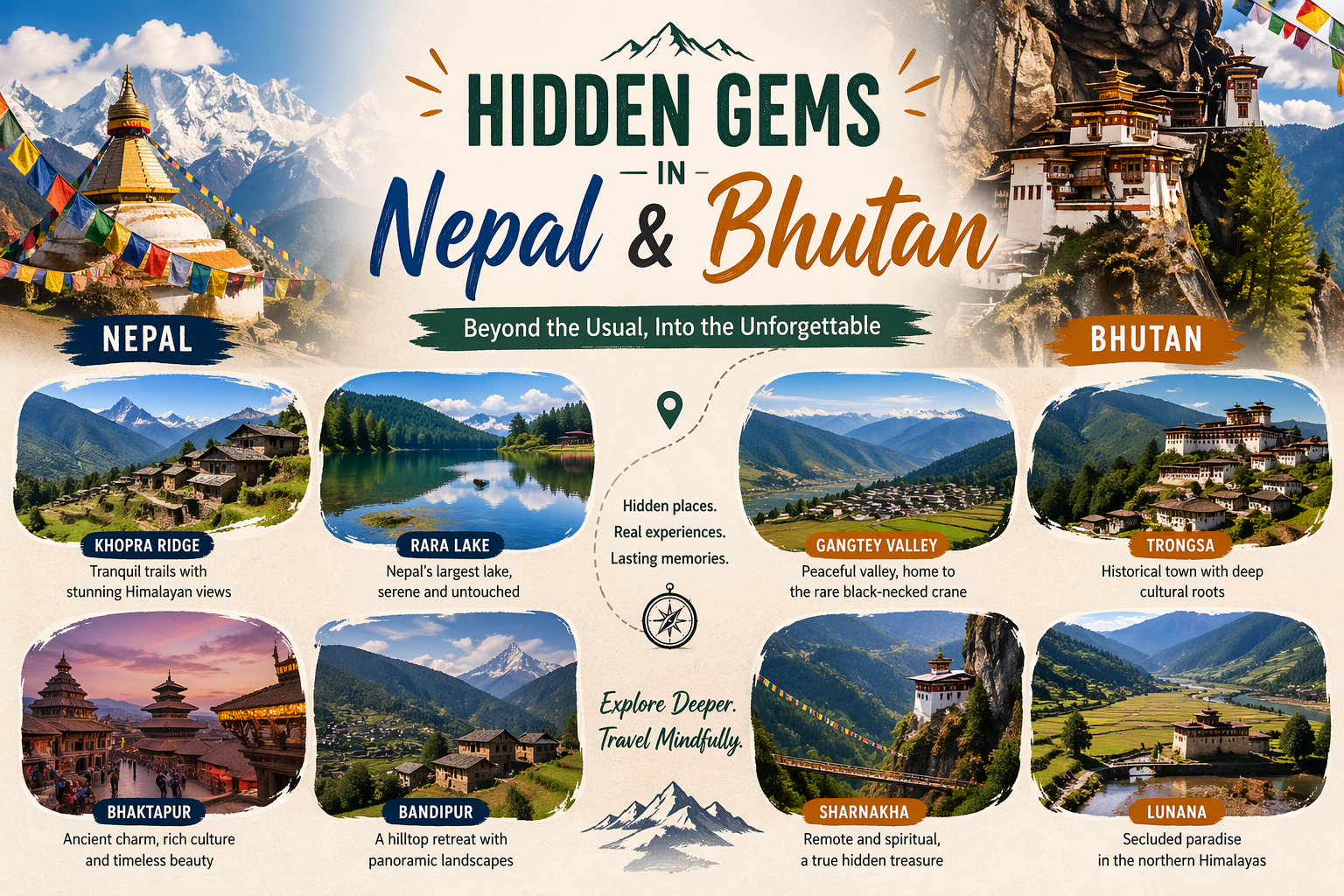
Explore beyond the highlights: The hidden gems in Nepal and Bhutan — less-visited valleys, local festivals, village homestays — are often more affordable and more memorable than the headline attractions.
New York residents planning to visit Bhutan will certainly find it to be very challenging to stage this trip, when for example, finding appropriate channels of communication is a major concern, given Bhutan can only receive tourists when congestion levels among airliners can be managed, keeping into consideration Nepalese requirement as well among others. Keeping these facts in focus, a Nepal & Bhutan tour package in Midasia Routes New York is thoroughly and comprehensively planned for the clients who wish to fly into Bhutan. That is, Bhutan visa acquisition, arrangements for tour operators and everything associated with the trip is included in the price of the tour package.
Many people residing in California often however prefer a Nepal & Bhutan tour package in California as it helps find a customized itinerary that is designed specifically with the USA west coast departure points and meeting schedules in mind without work interfering or too much annual leave being used. These are the Kailash trips level of Midasia Routes and they are aimed at the customers from Los Angeles, San Francisco, Bay Area the California citizens who wish to embark on a trip to the Himalayas and still continue with their normal schedules and spend realistic money on that trip.
People leaving the area of Florida who want to make a tour of Nepal and Bhutan and do not want to miss out on anything within this Vacation Package including the SDF fee which is a must to enter Bhutan, or the internal flights of Nepal which often surprise the visitors especially the first-timers, the cost implied for such services that can be offered from, will most efficiently be made in a tailor made package built especially in accordance with the client’s dates, price category and level of importance or rather travel goals.
The honest answer depends entirely on what you value in travel.
Exploring Nepal is met with little expense in return for the pleasure it gives. For a daily expense of less than $100 you can hike along the waterfalls and peaks famed by UNESCO, have delicious meals and see the base levels of the tallest mountains of the world. Compared to its cost, the big hyped affordable nepal trip is actually of quality — which is something you do not often find offered by the destinations in this range.
If Bhutan is cheap it would not have the same experience which is why Bhutan is expensive and rightly so. No crowds, only culture. All scenery and no mess. Old celebrations presented to tens and not creatures. From Nepal and Bhutan Tour Cost Breakdown turns more toward their travel ideology than the prices themselves.
For the majority of the first time tourists, a mid-tier commingled trip offers the greatest results. Nepal’s zest and sense of exploration, Bhutan’s calmness and profundity along with two weeks full of experiences to narrate even ten years from this day.
Nepal and Bhutan tour cost breakdown cannot be generalised — it entirely depends on the individual themselves. What remains constant at all levels is the standard of services attained against that financial outlay. Any visitor of Nepal and Bhutan who comes in very prepared, would not be short changed.
Come up with a real budget first. Comprehend what Bhutan’s SDF is so that one sets realistic goals. Set for yourself the kind of activities that are most important to you and undertake only those. Afterward, plan for the two countries so as to enjoy their best provision — hurries are not a virtue, and any country would not appreciate such emptiness.
1. What is the minimum total budget for a Nepal and Bhutan combined tour?
A realistic minimum for a 12-day combined trip, including international economy flights, Nepal visa, Bhutan's $100 per night SDF, budget accommodation in both countries, and mandatory guide services in Bhutan, is approximately $3,000–3,300 USD per person. Budget travelers can reduce Nepal costs significantly, but Bhutan's SDF creates a non-negotiable floor that applies regardless of accommodation or lifestyle choices.
2. What is Bhutan's Sustainable Development Fee and who pays it?
The Sustainable Development Fee is a mandatory $100 USD per person per night charged by the Royal Government of Bhutan to most international visitors. Indian, Bangladeshi, and Maldivian nationals pay a reduced rate. The fee funds Bhutan's free healthcare, education, and environmental conservation programs. It cannot be waived, discounted, or avoided, and is always quoted separately from your accommodation and package costs.
3. How does group size affect the Nepal Bhutan tour cost?
In Bhutan, guide fees and private transport are shared across the group, meaningfully reducing per-person costs. A solo traveler pays the full guide and vehicle cost alone; a couple splits it; a group of four reduces it further. The SDF remains fixed at $100 per person regardless of group size. In Nepal, group size affects accommodation and guide costs similarly — most operators offer better per-person rates for groups of three or more.
4. Does the Bhutan package price include international flights?
Generally, no. International flights to Bhutan — operated by Druk Air and Bhutan Airlines, connecting through Kathmandu, Delhi, Bangkok, or Singapore — are almost always quoted separately from the land package. The Kathmandu to Paro flight costs approximately $250–350 USD one way and should be factored into your total nepal bhutan tour cost calculation from the beginning of planning, not as an afterthought.
5. When is the most cost-effective time to do a Nepal and Bhutan tour?
February and late September offer the best balance of manageable weather and lower accommodation rates in both countries. Peak season prices (October–November and March–April) run 20–35% higher at most mid-range and luxury properties. However, always research conditions for your specific planned activities before committing to shoulder season travel — some high-altitude treks and certain Bhutan routes are weather-sensitive. The full seasonal guide at best time to visit Nepal and Bhutan covers each month in detail.
Want a personalized Nepal Bhutan tour cost breakdown built around your exact dates, group size, and travel style? Contact Midasia Routes for a custom quote — no templates, no guesswork, just a trip designed around you.
Your email address will not be published. Required fields are marked *