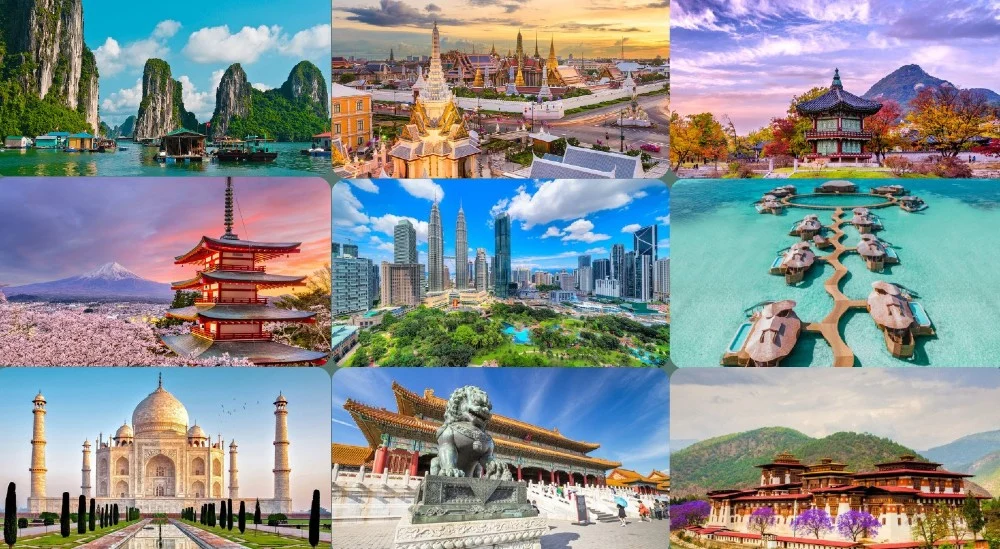
You experience the first moment in which your feet make contact with the icy stone surfaces of a thousand-year-old Kyoto temple while the incense smoke ascends to the heavens and the morning hours maintain their peacefulness. The Balinese cremation ceremony will leave you speechless because it presents a display of colors and music and religious devotion. The Asian cultural experience for travelers who want to discover its hidden gems, which exist beyond the swimming pool and tourist sites, provides actual cultural experiences.
Cultural travel Asia presents its most difficult challenge to travelers because its extensive scope proves too daunting to handle. The Asian continent contains more than 48 countries, which feature thousands of ethnic groups and multiple major religions and a complete history that extends back thousands of years. Which steps should you take to get started? You want to experience authentic local culture in Asia. How do you plan a heritage travel Asia journey that goes deep rather than just skimming the surface?
The guide provides answers to all the questions. The living temples of India and the ancient Cambodian kingdoms and the samurai cities of Japan and the northern Thai highland tribal communities all exist as cultural travel Asia destinations which offer you endless opportunities to discover new things. The ultimate guide to your journey starts here.
Defined as travel that seeks out the culture, heritage, customs, religious beliefs, languages and way of life of Asian people, cultural travels are undertaken in Asia. It is a tourist travel where a person chooses an experience, rather than just viewing scenery, participates or just watches and interacts with the situation, and meals are taken at the local places instead of posing for pictures and going to the next place.
Cultural travel Asia focuses on the aspect that concentrates on the physical inheritance of civilizations – like the UNESCO heritage sites, the old time trade routes, Middle Age performing arts, the ancient art of building and the useful structures that defied the laws of nature and time. Within all these, there is also the consideration of the present cultural practices, falling within the present cultural experiences, and involving living celebrations, current customs developing, old knowledge and practices surrounding those markets, and communal and kin state practices.
These two aspects combine to form the most fulfilling and comprehensive travel experience that one can possibly have on this planet. Asian culture-oriented travel takes a person beyond the geographical locations and brings them closer to individuals- to those strands of humanity that extend from the river Ganga to the Bali terraced rice fields, from the Great wall of China to the Halong Bay floating villages.
Why is it important? It is so because cultural travel Asia changes the tourists. Patterns of travel psychology indicate that profound satisfaction, emotions and self-improvement are most likely to follow cultural experience than any other activity based travel. The focus of the trip is not only to take pictures but also to return with an enhanced view of humanity.
Traveling for history and heritage, especially within Asia’s boundaries, cannot be more fulfilling than a visit to Kyoto does. The city that was once the Imperial City of Japan has no less than a thousand six hundred temples, four hundred Shinto states, around seventeen World Heritage Sites accredited by UNESCO, and an intact one thousand year old heritage.
When it comes to cultural travel Asia in the city of Kyoto, it is tiered on many levels. The basic one is the sites of the mentioned- Fushimi Inari’s eternal path of tori gates- the gold plated gilded temple of Kinkaku-ji, and the forenamed bamboo forest vales in Arashiyama. Those places without doubt are the beating heart of all the tourist activities and were indeed immensely popular within the visitors and rightfully so.
But in other places of cultural travel asia, one does not find more than Kyoto as far as the cultural experiences are concerned. In the district called Gion, you may see a female artist or a geisha making ways between the places during twilight, an existing tradition that has been practiced in its original form for over three hundred years. You can even participate in the Tea Ceremony in Uji where the preparation of matcha and savoring of tea takes place – a practice heavily influenced the Japanese aesthetics and considered one of the core components of Zen Buddhism.
Nishiki Market is a street market with narrow cover passage having pickles, tofu made afresh, meats on sticks ready to eat and sweetmeats sold by stalls, but that is a window into how kyoto's foodstuff was obtained over the years by the people of kyoto. Every single nishiki stall is an aspect of culture from asia in its most fundamental and enduring form.
If you want to enjoy kyoto in the most cultural travel asia way possible, then try to find an accommodation in a machiya townhouse or kyoumizu shukubo temple lodging, visit temples and participate in morning meditation; and also do not missout on the period of july which is the time of Gion Matsuri – one of the most magnificent asia traditions travel that the world has known.
While Kyoto is considered to be the center point for any cultural travel Asia, Varanasi is the spiritual core. Located on the banks of River Ganga in Uttar Pradesh, Varanasi is among the world’s oldest living cities and has been a renowned center for hindu culture , worship and observance for more than three millenniums.
On the Dashashwamedh Ghat every evening, the river Ganga Aarti takes place, a fire, bell, flower, and Sanskrit chanting ceremonial service performed by priests clad in silk bones and bestowing them training intellectually integrated thousands of pilgrims and travelers who come to the river banks and the boats anchored in the water. It is Asia's richest and most touching cultural experience, whether you are religious or not.
All about cultural travel Asia is waking up in Varanasi in order to Float into the Ganges river even as the city from the Ghats is still silent. You will be ready to witness the rites of cremation activities carried out out in the open on the burning stages – an honest and raw interface with death that lies at the heart of Hindu religious beliefs. Chanting of Sanskrit from the temples through the open windows, ash covered sadhus (ascetics) meditating, catacomb like streets of the ancient city full of silent silk weavers weaving the same ways as how they did 500 years ago are all what you will see.
One cannot look at cultural activities in Varanasi without considering its spiritual aspect of the people there. This city does not entertain tourists by replicating their practices; they openly embrace them and people’s participation is not prohibited.
Varanasi is transformative on its own — but as part of a wider India cultural circuit through Rajasthan, Jaipur, and Agra, it becomes something truly extraordinary. Our India tour package is designed for travelers who want to experience the full depth of the subcontinent's living cultural heritage, with expert local guides who bring irreplaceable personal knowledge to every ghats ceremony, temple visit, and market encounter.
Angkor, located in northwestern Cambodia, is undoubtedly the greatest symbol of architectural ambition throughout cultural travel asia. Its construction happened in the 9th or 15th century AD by the khmer empire. The ancient city of Angkor is more prominent in terms of built up area as it spreads over more than 400 square kilometers of land featuring many temples, roads, cities, lakes and canals – the relic of the former biggest urban area existing in preindustrial era.
Cambodia's temples are most powerful when experienced alongside the living cultures of neighboring Laos — one of Southeast Asia's most spiritually intact destinations. Our Laos tour package covers Luang Prabang's UNESCO-protected heritage town, its Buddhist monk alms ceremonies at dawn, and its extraordinary weaving village traditions — a natural and deeply rewarding cultural extension for any traveler who has been moved by Angkor.
The Angkor Wat – the focus point of the complex and the biggest existing religious structure – is among the best examples of such symbolic building art. Such a structure, each section of it, each statue or relief and each design is deliberate, placing every aspect of the Cambodian hierarchy, myths and even symbolism embodied in the stones. One can rightfully state that this is one of the main things Asia has to offer for cultural tourists – obliquely or directly. Giving temple's halls a walk at dawn as the sandstone takes a golden hue is something every explorer has to do at least once.
Besides Angkor Wat, the cultural travel Asia perspective of visiting the famous Angkor gets wiser. One finds it difficult to ignore the philosophical aspect of the Bayon temple with its 216 human stone sculptures looking stone faces looking in all directions. Visiting Ta Prohm, a temple which over generations has heaps and heaps of trees growing over and out of its walls, portrays a line of discord to such thoughts. The very small temple of ultramarine color with all its flaxen carvings is without a doubt the most exquisite decorative artwork found in the country.
People who travel for cultural experiences in Asia will also want to do more than just see temples in Siem Reap, the city that serves as the entrance to Angkor. Phare Cambodian Circus, a social enterprise utilising graduate performers of At-Risk Youth Circus School, stages spectacular circus shows that incorporate grounded elements of Cambodian culture and history. Classical apsara, or female temple dancers are also offered in venues that promote traditional culture in the region, functioning as a direct line to the art still evident on temples within Angkor.
In very few locations can a more vibrant and engaging culture be found than in Bali. The island in Indonesia is renowned for its beaches and rice paddy fields however, none more so than the cultural travel asia in Bali; a conceptual and everyday practice where the components of Hinduism, art, community and day-to-day life are inextricably linked.
Balinese Hinduism — a marriage between Indian Hinduism and the aboriginal spirit- based beliefs of the people of Bali — is at the heart of all the activities. It is the men and women who wake every morning with this simple devotion of such adorations that men and women prepare nasi, kawung, and kemenyan (kain or kain-kebaya) kaya, 10-4 putuskab24 flowers which they place outside their homes, establishments and temples respectfully as a way of thanksgiving and pacifying the souls. Every single day there are ritual services, be it in the temple compound, by the road junction or beach, to which the entire island turns out with joy and appreciation.
Ubud village is regarded as the center of culture in Bali and is most suitable for cultural travel Asia undertakings on the island. Go to Uluwatu Temple once the sun goes down, and witness the Kecak dance – a captivating form of ancient Balinese theatre performance performed to the sound of men chanting sounds. Experience a balian traditional medicine practitioner and observe food and health-based concepts of culture. Learn how to make batik fabric or silver jewelry or even carve wood in some of the many workshops scattered across Ubud.
In Bali, asia traditions travel alterations included the Nyepi Day which is the Balinese New Year’s Day and also the Day of Silence. Every activity stops, even the airport. It is rather difficult to describe such an asian cultural activity because it has is one of the most intense in the continent.
Planning truly immersive cultural travel Asia requires a different approach from standard sightseeing tourism. Here is the process that experienced cultural travelers follow.
Step one: Choose depth over breadth. The single biggest mistake in cultural travel Asia is trying to cover too many destinations too quickly. Two weeks in one region yields vastly more cultural understanding than two weeks across eight countries. Choose one country or even one region, and commit to going deep.
Step two: Research the cultural calendar before booking flights. Many of the most extraordinary cultural experiences Asia offers are tied to specific festivals, ceremonies, and seasonal events. The Pushkar Camel Fair in Rajasthan, the Songkran water festival in Thailand, the Tet celebrations in Vietnam, the Lantern Festival in Taiwan — these events transform already remarkable destinations into something truly transcendent.
Step three: Arrange homestays and community-based tourism. The most authentic local culture Asia encounters happen not in hotels and tour buses but in family homes and community settings. Homestay networks in Vietnam, India, Japan, and Bhutan connect travelers directly with local families who share meals, stories, and daily life in exchange for modest accommodation fees.
Midasia Routes has deep community connections across Asia's most culturally rich destinations — from family-run guesthouses in Bhutan's monastery villages to heritage haveli stays in Rajasthan. Our custom travel planning service places cultural immersion at the center of every itinerary we build, connecting travelers directly with local families, craftspeople, and community guides who bring living culture to life in ways no standard tour can replicate.
Step four: Hire local cultural guides, not generic tour operators. A local guide who grew up in Varanasi or Luang Prabang brings irreplaceable personal knowledge, language skills, and community connections that no generic tour can replicate. Look for guides recommended by cultural NGOs, heritage conservation organizations, or platforms that specialize in responsible heritage travel Asia.
Step five: Learn foundational phrases in the local language. Even ten words of Vietnamese, Thai, or Bahasa Indonesia transform how locals receive you. It signals respect and genuine interest — the two qualities that open doors in cultural travel Asia that remain firmly shut to those who do not try.
Step six: Read before you go. A novel set in your destination, a history of the civilization you are about to encounter, or a memoir by a local author provides cultural context that makes every experience richer. For Japan, read Pico Iyer. For India, read William Dalrymple. For Cambodia, read David Chandler. Cultural travel Asia rewards the prepared mind.
In general, it is advised to prioritise secondary cities over the capitals. This is because the richest forms of cultural travel asia are usually not offered in these areas. For instance, between respective cities of Vietnam, Hoi An is far better than Ho Chi Minh. Same with Kanazawa and Tokyo. It is also applicable to Mysore and Bangalore. The secondary towns have been nurtured and developed with minimal unnecessary interference due to the development of tourism and the fast pace of developments of such environments.
Worship with the locals but do it with respect. For instance, the morning chants of a monk in the monastery, or salaat on a Friday in Penang or pooja in the temple in Varanasi - these are unpoliticised; uneconomic, unattached acts of collective worship where most if not all the observers are welcome so long as they do not criticize the act. Attending an actual religious ceremony is an indescribable unforgettable experience that none of the cultural experiences asia within a museum on that religion can ever be compared to.
Look for cultural aspects that no touch can reach. There is also an institution responsible for universe’s physical aspects, which one it’s called UNESCO, but also UNESCO is known because of the other concept of the intangible cultural heritage – this is the traditions with music or dance or history, or crafts, but it is something that lives. Enough said, each country uses every possibility and surpasses the others with the amount of UNESCO intangible heritage Asia. Find out what traditions are living that exists at the destination and how they can be included in the list of must do things.
At this point, it is obvious that I am dictionary.com. To put it, comparing to, if we take for instance my country where an individual would go to Luang Prabang, and purchase a handwoven textile, and then buy the same ceramic hand-painted work of art in Jingdezhen or procures some block-printed fabric from Jaipur from the people who make them instead of the shops which sells, I get it – the ways of making those things together with the community and the craft, survives economically. This is what most cultural travel Asia recommend, it is the most thoughtful, but also the most astounding.
Visit when it is least busy. For the most popular and historic places in Asia, such as Angkor Wat at daybreak and the Kyoto temples when the leaves turn red, visitors are a bit much to handle in the high season. Cultural travel Asia before or after the peak season (which is a month each way) lowers the number of visitors significantly so that the visit can be much more personal.
Supporting artisan communities through direct purchases is one of the most meaningful acts a cultural traveler can take — and Nepal and Bhutan offer some of Asia's finest living craft traditions. Our Nepal and Bhutan tour package builds direct artisan encounters into the itinerary — from Bhutan's handwoven textile villages to Nepal's thangka painting studios — ensuring your cultural experience creates genuine economic benefit for the communities that sustain these traditions.
The best and most common mistake incurred in heritage travel Asia is galloping between appraising various UNESCO musses with little interest in scrutinizing the living culture. Hopping from one temple to another and checking them off the list yields a lot of pictures but little comprehension.
When not dressed properly during one’s visits to religious places, it is polite to expect to be turned away since such dressing is disrespectful. While in cultural travel Asia, it is appreciated that one covers shoulders and knees in temples, mosques, and shrines throughout the continent. Know what dress code is acceptable before going to any of those sites.
Relying on English speakers among the locals greatly distorts one’s understanding of the culture in Asia. Those individuals who are often the most educated, active, and knowledgeable about their culture are generally the least opposite in terms of their ability to speak and converse in English.
The acts of photographing ceremonies, rituals or people without permission and awareness belongs to the class of violations that drive a wedge between the relations of travelers and the host population. Make sure that one checks first before taking any picture while in a cultural situation during asia traditions travel.
Remaining in international hotels and exclusively the chains does indeed keep you away from experiencing the culture in Asia. Spending time even in a single night in a classical Japanese ryokan, Balinese family compound or an ancient Rajasthani haveli would broaden one's horizon about the place more than staying in a five-star international hotel for a whole week.
Another sad mistake would be to conclude that the term “traditional” automatically depicts something ‘frozen’. Unfortunately most cultural travel asia savvy individuals do not make this mistake. Mankind and the world changes. The Balinese dancing tradition you watch today for instance has been shaped and reshaped over a very long period of time by the people of the island with the help of artists as well. Thus, valuing or acknowledging any culture is cognizance of its ability to change rather than it’s preservation as it is.
Drawing heavily on guidebooks implies missing out on the cultural experiences that Asia offers which are embedded in the haphazard travels – a family that shares their table with you, a fair in the village that you come across as you wander the streets, a craftsman welcoming you to his workshop. Allocate some time for serendipity in every cultural travel Asia trip.
Travelers researching cultural travel Asia at a deep level often use these specific search phrases. Understanding them helps you find the experiences that match your particular interests.
“Cultural travel Asia As A Woman” – Japan, Bhutan, Taiwan and Singapore are the first on the list of best cultural travel Asia solutions for females.
‘Cultural Experiences Under $50 A Day’ – Thousands of destination tourists are able to experience Vietnam and Cambodia, fols Ampec Cambodia, Laos, and Nepal, as these particular destinations bring along the best heritage travel Asia has within the lowest budget so far, which implies profound engagement in culture on nearly all types of consumers.
“Family travel in Asia achieved through traditions” – Facilities for families with children are best Jordan, Malaysia and Thailand, within the limitations of cultural tours of Asia, including temples that children can visit, interesting hands-on crafting, as well as traditional festival participations.
“Cultural Spiritual Travels In Asia Retreats” – The majority of the spiritual heritage travel Asia offering is dominated by India (Rishikesh, Varanasi, Dharamsala) offering spiritual retreats, Sri Lanka (the forest monasteries), Burma (the monastery stays in Bagan) and Bhutan (Buddhist retreat programs).
Sri Lanka's forest monastery tradition offers one of Asia's most accessible spiritual retreat experiences for culturally motivated travelers. Our Sri Lanka tour package ventures beyond Colombo's colonial heritage and the ancient ruins of Polonnaruwa into the island's living Buddhist monastery culture — a profound and unhurried cultural experience that complements the more intense spiritual landscape of Varanasi and Bhutan perfectly.
"Cultural tours in Asia with cameras" — Rajaistic settings at the fort of Jaisal where the sun knocks off, Baga’s landscapes covered with temples at dawn, Geisha steps in Kyoto under the darkening sky and Luan Prag a flock of monks in the before light are the best cultural tours for the Asian continent.
Identify the top best cultural travel country in Asia is a true challenge. There’s that much quality of all the countries. When it comes to aesthetics included, history and place availability, few if none can compare to the Japanese: the cultures of temples, traditional arts and cuisines, are some of the most advanced and maintained which one can ever come across. As for cultural density and diversity, India is far ahead of every other nation in the world–as no single country packs so many civilizations, languages, gears of art and religions within its boundaries. Cambodia, Bhutan, and Sri Lanka are known for more specific heritage cultural travel asia packages. In conclusion, the best cultural travel asia destination is the one that matches your preferences the most.
Deciding which country is the most culturally rich tourism destination in Asia may prove to be a challenging undertaking as the competition is very stiff. Nonetheless, Japan seems to be leading in the majority of cases because of the unique elegance, rich history, and present Ustars eation: history culture and traditional temple culture arts as well as the Japanese cuisine are quite arguably the finest and most intact in the world. Of the current contenders, India offers the greatest competition when it comes to pure culture — one culture, language, art, and religion in form or the other can be found in one nation. Asia in general is often associated with heritage tours though Cambodia, Bhutan, and Sri Lanka are notable exception for unique another types of experiences in the region. In the end, picking a particular country for cultural travel in Asia comes down to what from the variety best suits your needs.
Absolutely, as a matter of fact, some of the best cultural travel Asia travels in the world are available to backpackers and low cost travelers. Observing Buddhist rituals in a functioning temple in Luang Prabang does not cost anything. It costs nothing to watch the morning monkey procession in Chiang Mai. It also costs only few dollars to visit many of South East Asia’s best cultural heritage sites, inclusive of a few of restricted UNESCO proclaimed areas. This kind of heritage travel Asia in Vietnam, Cambodia, Laos, Nepal or India is well affordable at around twenty dollars and thirty to fifty dollars per day including meals, accommodation, transport and cultures.
Cultural norms are considerably different in most of the places included cultural travel asia, although some factors can be generalized. In most Asian countries, people remove their shoes before accessing temples, mosques and private homes. Conservative clothing should be observed at holy places (minimum shoulder and knee coverage). The practice of receiving food or gifts with both hands as a social etiquette is regarded very highly in Japan, Korea and most of Southeast Asia. Do not point your feet at something or someone sacred, especially if it relates to Buddhism or Hinduism. Do not handle religious or spiritual items or representations unless allowed. During events try photographing, but always take permission when clicking on people. Such basic propitiations will save your bacon in most cultural travel asia locations.
Asian continent has a vast number of festivals and travelling 'especially on cultural travel Asia' when there is a festive period, is amusement at a whole new level. Diwali of India (October/November) called as festivals of lights is absolutely fascinating as well as touching at every sense. Thailand's Songkran in April, a waterty tradition means New Year’ s celebration which is one of those, which so evidently is the most involve and one of the rare traditional cultural travel events in Asia. The Japan’s Kyoto Gion Matsuri held every July is the most famous traditions of them all. Tet, also known as Vietnamese New Year, in January / February is a cultural identity of Vietnam which is quite rare. The famous camel fair in Pushkar, Rajasthan (November) is another one of the rich lineage cultural travels asia and one of the endlessly artful and colorful panorama in the planet.
Meaningful cultural travel Asia journeys could last long or short depending on one’s preference. Two weeks spent exploring a single country-Japan, Indonesia, or India, tends to afford one relatively deep appreciation for these cultures when every day is spent on an activity that is relevant to that nation. A month long trip will be enough to visit two to three places in the country at least for more than just a surface tour. To better understand the concept of cultural travel Asia, it is necessary to consider the point of view of someone who can spend months in one place, practicing its culture, like learning the language and creating a supportive environment around oneself – something that would be impossible on short vacations. When the three month duration is the minimum worth of engaging to any culture, short at least five days are key – attending a culture for Asia less than this timeframe gives one meaningless experiences.
A tailor made tourism in Asia relates to how people get to experience in the most immersive way possible the civilization heritage. They visit cities, towns, villages and the countryside rich in archaeological sites and historical monuments and old art forms, old building and preservation of all traditional knowledge.
In heritages tourism it is the pride of the people creating their own legend with the guests – the places they respect are postponed for future generations (e.g. historic centers). Other spheres of tourism are called cultural tourists – contemporary civilization including that of festivals, religions, artworks and practical living matters.
Allowing for this intricate balancing is what cultural travel asia is about. This is the phenomenon which joins these dimensions of ‘fixed’ and ‘hybrid’ cultures through different activities which make the community become a proud bearer of her heritage and cultural practices.
Among the many cultural travel Asia places visited around the world, Bhutan is one place that exceeds all expectations no matter how high the price tag attached to it is. The mountain kingdom took this bold step to manage tourism in order for the country's culture to remain intact. Hence tourists must pay extra to stay here as they have to pay sustainable added endowments implementation fees per day. It is true what they say that when you go to that place you enter the depths of a Buddhist tradition that has been preserved for a great many years - administrative centers and monasteries housed in such architectural buildings called dzongs, traditional building styles that are required by law, tze-chu }masked and ritualistic dances during festival sas well as the idea of enhancing a nation’s well-being rather than its wealth that is GDP. Envisaged for the most demanding cultural travel Asia tourists, Bhutan is one of the most satisfying travel countries in the entire world.
Bhutan is without question the crown jewel of cultural travel in Asia — and it becomes even more rewarding when combined with Nepal on a single Himalayan cultural journey. Our Nepal and Bhutan tour package pairs both kingdoms into one extraordinary itinerary — combining Nepal's living Buddhist and Hindu heritage with Bhutan's pristine, government-protected cultural landscape in a journey that represents the pinnacle of heritage travel Asia has to offer.
In cultural travel asia, participating in voluntourism is one of the most pleasurable when handled with care. The point is that you need to support organizations which have community benefit at the epicenter, not the travelers’ benefits. It is better to join cultural conservation activities; temple restorations, supportation of craft centers, community-English through BID or cultural NGOs' programs. Please do not start any program that turns communities into beneficiaries and not doers of their own developments. Better of the cultural volunteerism Asia can be defined as programs where the skills area is more of the community’s advocate as opposed to touristic developmental occasions which warrant good payable story-telling.
When questioning the most populated places in the whole of Asia that are relatively unheard of in terms of the cultural travel Asia communities, experienced travelers are always pointing to Luang Prabang in Laos (a city under UNESCO protection due to its significant architecture and preserved radical Buddhism while not flooding flocks of tourists); Kanazawa in Japan (dubbed ‘little Kyoto’ due to the presence of former samurai quarters, the geiko/maiko culture and mostly, the crafts practiced in the city but without the influx of tourists like Kyoto); Yogyakarta in Indonesia (considered the cultural core of Java where Borobudur and Prambanan, two of the significant religious complexes in Asia, are located); Hampi in India (which is a desolate as well as picturesque terrain full of scattered ruins from the once great kingdom of Vijayanagara); and finally Hoi An in Vietnam (with excellently preserved ancient commercial port and elevated age old art and food traditions.
Practitioners exploring Asian culture don't view it as a commodity that one pays for, but a practice that one can only develop over the years. No temple passes by unnoticed, no ceremony with ordinary perception: participation in the lives of these extraordinary peoples is very welcome. And this is why each one of them enriches the individual who places himself in the most diverse culture on the planet.
The places suggested in this travel guide — from the rock-cut temples of Angkor Wat to the waterside mornings at Varanasi, from the flower-filled offering streets of Ubud to the hanas of Kyoto — are the exquisite examples of the helm work of humanity over the centuries. You are delving in all that when you engage in cultural travel Asia.
Yet those well known travel accords in this remarkable survey fail to cover the most exquisite tourism in Asian history. It’s in the overlooked occurrence – the talk to the workman at his workshop, the pageantry that arises out of nowhere, the locals who, without any prompting, ask you to join in their meal. Reach out with curiosity, take expenses and. be patient, because cultural travel Asia is able to provide more than is laid down in any schedule.
Advance your honorable heritage travel Asia. Determine a suitable place for your engagement. Penetrating within the borders of the continent comes later after all this has been done- the universe has incarnated for over history of human collectiveness for over three millennia and is still willing to do so for any interested person.
Your cultural travel Asia journey deserves more than a list of UNESCO sites and a hired bus. Midasia Routes designs bespoke cultural itineraries built around living traditions, community connections, and the kind of human encounters that standard tour packages never reach. From small group cultural expeditions through Southeast Asia's heritage heartlands to fully custom private journeys across India, Bhutan, and Japan, we build cultural travel experiences that genuinely change the way you see the world. Contact our team today and let's start crafting your most meaningful Asia journey yet.
Your email address will not be published. Required fields are marked *