Georgia tours from the USA are easy to plan on paper. The US State Department rates Georgia Level 1, Exercise Normal Precautions, in an advisory issued on March 13, 2025, and American citizens can enter without a visa. The only places it tells travelers to avoid are the Russian-occupied regions of South Ossetia and Abkhazia, which are not on any normal itinerary. That makes Georgia one of the more approachable countries in the Caucasus, and one of the few where wine, mountains and medieval monasteries fit into a single trip of a week or two.
This guide is for travelers who are comparing Georgia tours and want a clear view of the route options before they speak to an operator. It covers entry rules, the best months, the main regions, the difference between a cultural trip and a trekking trip, how many days to allow and what to ask before you pay a deposit. It also shows where a private Georgia journey differs from a group departure.
The advisory describes Georgia as generally safe for travelers, and rates it at the lowest level the Department issues. It marks South Ossetia and Abkhazia as Level 4, Do Not Travel, because of crime, unrest and landmines. Those regions lie outside the areas visitors normally cover, and the Administrative Boundary Lines are closed to ordinary travel from the Georgian side.
Advisories change, so read the current version on the State Department website before you book.
US citizens can currently visit Georgia without a visa for up to one year. You need a passport that is valid for the length of your stay, and you may be asked for proof of onward travel and sufficient funds. Rules can change, so confirm them with the Georgian authorities or your operator close to your departure date.
The best time depends on what you want to do.
Tusheti is the clearest example of why timing matters. The road to Omalo crosses the Abano Pass at roughly 2,800 meters, and it is generally open only in summer, from about June to October. If a trek to the hidden villages is your reason for going, plan inside that window.
The capital sits along the Mtkvari River, with an old town of carved wooden balconies, sulfur baths in the Abanotubani district, churches, cafes and a growing restaurant scene. Allow two nights, with time for the Narikala Fortress and a long dinner of khachapuri, khinkali and local wine.
Mtskheta, the ancient capital, is a short drive from Tbilisi and holds two UNESCO-listed churches, Jvari Monastery and Svetitskhoveli Cathedral. From there, the Georgian Military Highway climbs north past the Ananuri fortress and the ski resort of Gudauri toward Kazbegi, also called Stepantsminda.
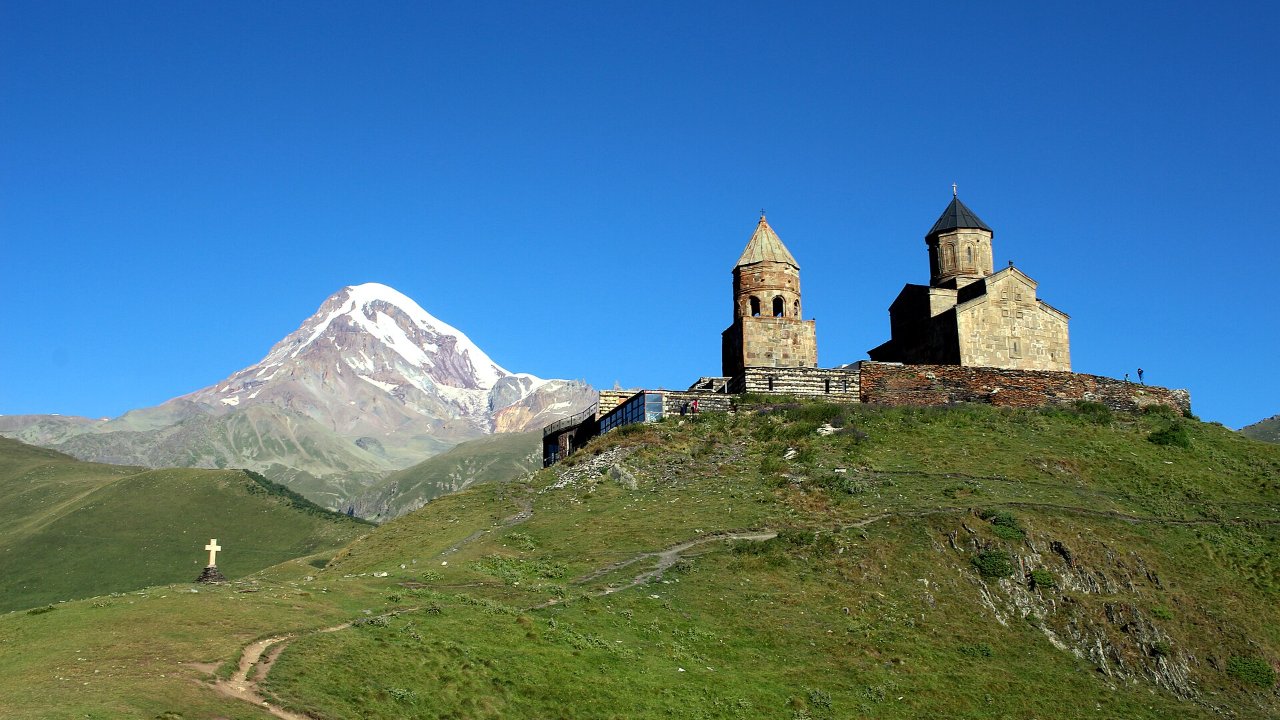
Gergeti Trinity Church stands at about 2,170 meters beneath Mount Kazbek, one of the best-known views in the Caucasus. Day hikes, a trail to Juta village and a walk toward the Chaukhi massif are all common. The weather can turn quickly, and clouds often hide the peak until morning or evening.
Kakheti, in the east, produces most of Georgia's wine. Many producers use qvevri, large clay vessels buried in the ground, a method recognized by UNESCO. Tastings in family cellars are the high point, along with the hilltop town of Sighnaghi and the Alaverdi Monastery. A winery day usually works best as a slow lunch and a few tastings, not a long list of stops.
The David Gareja monastery complex lies in a semi-desert on the border with Azerbaijan, and the area around it is subject to a boundary dispute, so go with a guide who knows which parts are open. Vardzia, a cave city carved into a cliff in the south, and the rock-cut town of Uplistsikhe near Gori show how deep the region's history goes.
Svaneti, in the northwest, is known for medieval stone towers and the high village of Ushguli. Tusheti, in the northeast, is a remote region of stone villages such as Omalo, Dartlo and Shenako, reached by one of the more dramatic mountain roads in the country. Both are rewarding, and both require more time and a good guide.
Georgia tours generally split into two types. A cultural trip links Tbilisi, Mtskheta, Kakheti and the Kazbegi area by car, with short walks and long meals. A trekking trip uses guesthouses and takes you on foot into the high villages, with several days of walking and a lighter focus on cities.
Our 11-day Georgia journey, High Trails and Hidden Villages, leans toward the second style. It runs from Tbilisi and Mtskheta through Tusheti villages such as Shenako, Chigo, Dartlo and Omalo, then to Kakheti, Stepantsminda, Gergeti and Juta. If you want a longer route that crosses borders, the Caucasus journeys on our site link Georgia with Armenia and, on one route, Azerbaijan.
| Length | What fits | Best for |
|---|---|---|
| 5 to 6 days | Tbilisi, Mtskheta, Kazbegi, one wine day | A first look, short on time |
| 8 to 10 days | The above plus Kakheti, Vardzia or Uplistsikhe | Most first-time visitors |
| 11 to 14 days | Everything above plus Tusheti or Svaneti trekking | Walkers and repeat visitors |
Georgian food is one of the reasons people come. Khachapuri, a cheese-filled bread, appears in regional versions, and khinkali, spiced dumplings, are eaten by hand. Look for badrijani nigvzit (aubergine with walnut paste), lobio (beans), grilled meats and fresh herbs at every meal. Vegetarians do well here. Wine is part of the table, and a supra, the traditional feast, comes with toasts led by a tamada, the toastmaster.
Most American travelers fly into Tbilisi, usually with one connection in Europe or the Gulf. Flight times from the US East Coast are typically long, so many travelers plan a rest day on arrival. Batumi, on the Black Sea, has its own airport and suits a beach extension in summer.
A group tour offers a set price and a set pace. A private tour lets you decide how long to stay at a winery, whether to add a hike, or when to skip a stop that does not interest you. In the mountains, a private guide can also adjust to the weather, which matters when roads and trails depend on conditions. Families and travelers with mixed fitness often prefer the flexibility.
A good operator answers these in writing. If you already have dates and a group size, share them and we will outline a route that suits your pace.
Georgia pairs well with Armenia, whose monasteries, Lake Sevan and Yerevan are a few hours south. See our guide to Armenia tours from the USA for the other half of that route. Travelers who enjoy long journeys can continue east along the Silk Road; our overview of Uzbekistan tours shows what that leg looks like.
This route suits travelers who prefer cars and comfortable beds to long walking days.
The shape can change. If Svaneti or Tusheti is the priority, you would trade some of the cultural days for travel and trekking days.
Tusheti trips are not like a city break. The walking days link stone villages along old paths, with guesthouse stays and home-cooked meals. Days of three to six hours on foot are typical, with moderate climbs, and the altitude is mainly between roughly 1,800 and 2,900 meters. The Abano Pass road is rough and can be closed by weather or rockfall, so transfers can run long, and the first and last days are partly for getting in and out. Pack warm layers, a rain jacket and broken-in boots.
The guesthouses are simple. Expect shared bathrooms in some villages, set meals with homemade bread and cheese, and limited phone coverage. For many travelers, that is the point.
The currency is the Georgian lari. Cards are widely accepted in Tbilisi and larger towns, but carry cash for villages, markets and small guesthouses. Georgian has its own script, so a few phrases help, though English is common among younger people in the cities and in tourism. Mobile data is inexpensive, and a local SIM or eSIM is easy to set up on arrival. Tipping of around ten percent in restaurants is normal when service is not included.
Batumi, in the southwest, is a resort city with a seafront boulevard, a botanical garden and a lively restaurant scene. It suits a few relaxed days at the end of a mountain trip, especially from June to September. Svaneti and Batumi can be combined by road or by a domestic flight, depending on timing. Ask your operator whether a beach extension fits your dates.
Georgia works well for families and for travelers who prefer a gentle pace. A cultural route has short walks, comfortable hotels and long lunches, and a private driver removes the stress of mountain roads. Trekking routes are more demanding, so be honest with your operator about fitness and knee or heart concerns. Altitude in Kazbegi, at around 1,700 meters in town, is moderate, but the church walk climbs further.
Georgia tours reward a slower pace. The Level 1 advisory, the visa-free entry for Americans and the mix of wine country, old churches and high mountain villages make it one of the easiest places in the region to plan. Choose the season for the region you want, decide early between a cultural and a trekking trip, and keep a spare day in the mountains.
If you would like help, tell our team your dates, group size and walking comfort, and we will shape a private route. Explore our private Georgia journeys to begin.
Your email address will not be published. Required fields are marked *