From January 1, 2026, US citizens can enter Uzbekistan without a visa for up to 30 days, following a presidential decree that extended a facility previously limited to travelers aged 55 and over. That change removes the main paperwork barrier for Uzbekistan tours and arrives as the country's Silk Road cities are better connected than at any point in their modern history, with a high-speed train linking Tashkent, Samarkand and Bukhara.
This guide is for travelers who want to see Samarkand, Bukhara and Khiva and need to know how many days to allow, which season to choose, how the trains work and what kind of tour suits them. It includes a sample 10-day Uzbekistan itinerary, practical entry and safety information, and an overview of private, small-group and luxury rail journeys across the Silk Road.
Three developments have made planning simpler. The visa-free regime for US citizens covers stays of up to 30 days, which comfortably includes a classic 10 to 14 day tour. The State Department rates Uzbekistan Level 1, Exercise Normal Precautions, in an advisory issued in January 2026. And the rail network now handles most of the long distances between the great cities.
The advisory still contains sensible cautions. Avoid protest areas, use officially marked taxis, guard your cards and PIN in crowded places, avoid tap water, carry medical evacuation insurance because local care is limited, and stay within the 30-day limit. Hotels register foreign guests with the authorities, so keep the registration slips you receive, since immigration officers may ask to see them when you leave. Always check the current advisory before you travel.
Most tours begin in Tashkent, a large, green city that mixes Soviet-era planning with older neighborhoods. The Chorsu Bazaar is a good first stop for bread, spices and dried fruit, and the metro stations are decorated like small palaces. One or two days is enough before you head west.
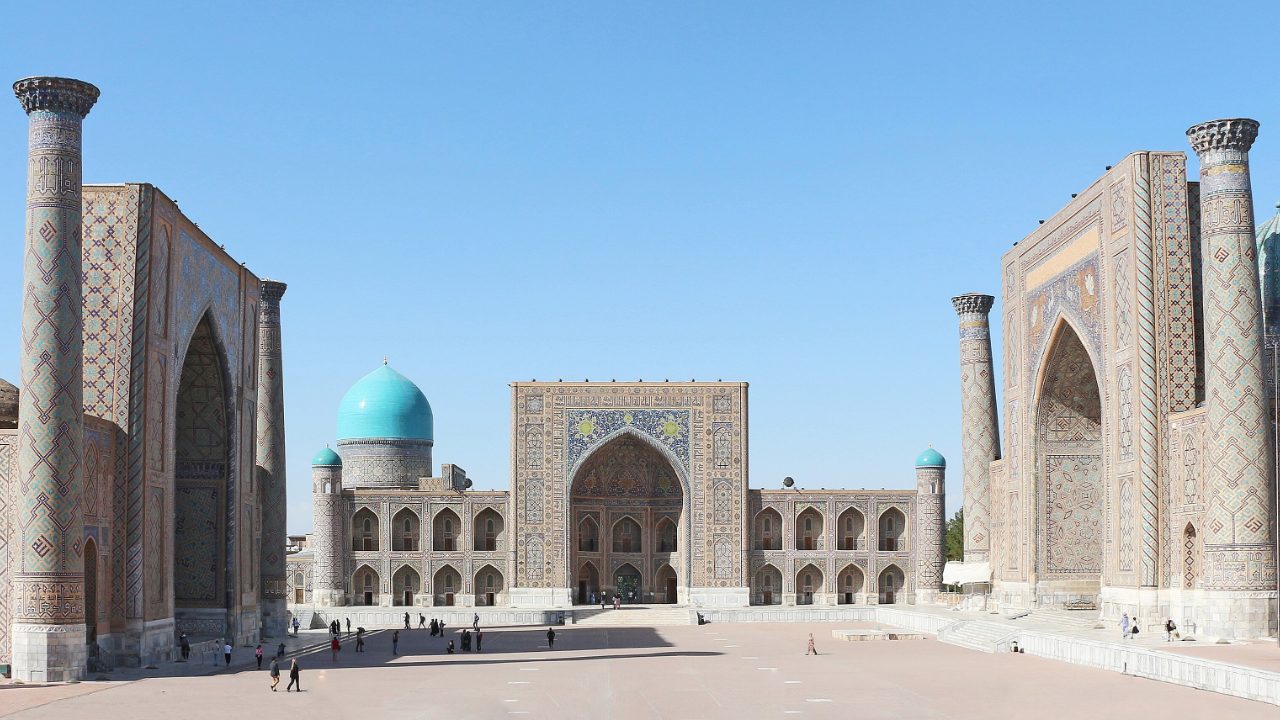
Samarkand is the emotional high point for many travelers. The Registan square is framed by three madrasas, built between the 15th and 17th centuries and covered in blue tilework. Nearby, the Gur-e-Amir mausoleum holds the tomb of Timur (Tamerlane), and the Shah-i-Zinda necropolis is a lane of tiled tombs that rewards slow walking. A day trip to Shahrisabz, Timur's birthplace, is a good addition.
Bukhara feels more lived-in than Samarkand. The Poi Kalon complex centers on the 12th-century Kalyan Minaret, the Ark fortress overlooks the old city and the pool-side square of Lyab-i-Hauz is where residents gather in the evening. The trading domes of the old bazaar still sell silks, ceramics and suzani embroidery.
Khiva's inner city, Itchan Kala, is a UNESCO World Heritage Site surrounded by mud-brick walls. Its turquoise Kalta Minor minaret, left unfinished, is one of the most photographed monuments in Central Asia. Khiva is remote and quiet in the evening, which is why many travelers rank it among the best nights of the trip.
A week lets you see the four main cities with about a day in each, but the pace is rushed. Ten days is the practical minimum, with two days each in Tashkent, Samarkand and Bukhara and an extra stop in Khiva. Two weeks adds Karakalpakstan, including Nukus and the Aral Sea region, and three weeks or more allows the Fergana Valley or a combination with a neighboring country.
Here is a sample Uzbekistan itinerary for 10 days that private travelers often use as a starting point.
The best seasons are spring (April and May) and autumn (September to early November). Daytime temperatures usually sit between 15 and 25 degrees Celsius, which is ideal for walking tours of exposed sites. Summers are fierce, with temperatures often above 40 degrees, and the old towns offer little shade. Winter is the quietest season for tourists, with days around 0 to 5 degrees Celsius and very cold nights, so it suits travelers who prefer empty monuments and warm hotel rooms over long walks.
The Afrosiyob high-speed train is the highlight of Uzbek travel logistics. It connects Tashkent and Samarkand in about 2 hours 20 minutes and Samarkand and Bukhara in about 1 hour 40 minutes. Tickets are released roughly 45 days ahead and sell out quickly in the high seasons, so independent travelers need to book early. The leg between Bukhara and Khiva takes around six and a half hours on a slower train, and many private tours use a car and driver or a domestic flight on that part of the route.
A private operator books train seats, hotels and transfers together and meets you at stations, which removes the most stressful part of independent travel.
The right format depends on pace, budget and interests. A private tour lets you choose the hotels, set the pace and add craft workshops or longer evenings. A small-group tour suits travelers who like company and a fixed schedule. A luxury rail journey turns the train into the hotel and covers long distances while you sleep.
Our Uzbekistan tours include three long-form journeys.
The longer routes start in the Caucasus, so you can pair Uzbekistan with a Georgian wine and mountain journey. See our Georgia tours for that side of the region.
For a wider view of the cultural side of Asian travel, read more: Cultural Travel Guide: Explore Traditions Across Asia.
Uzbek cuisine centers on plov, a rice dish cooked with carrots and meat, along with samsa pastries, lagman noodles and round flat bread called non that is baked in clay ovens. Meals are shared and generous, and tea is offered constantly. Fresh fruit and dried fruit are excellent at markets in late summer and autumn.
Craft traditions are part of the journey. Rishtan is known for its blue and green ceramics, Margilan for silk woven in the Fergana Valley, and Bukhara and Samarkand for suzani embroidery and carved wood. A good itinerary includes workshop visits where you can see the makers at work and buy directly.
A private tour suits couples, families and anyone who wants flexible days, late mornings or extra time at a site that captures them. A small group suits solo travelers who like company and a set schedule, and it can lower the cost per person. Either way, a local guide matters more here than in many destinations, because the history of the Timurid, Persian and Soviet periods is layered, and an informed guide makes the architecture readable.
Send us your dates and travel style and we will draft a route. Request a custom Uzbekistan itinerary.
If you have more than ten days, a few additions deepen the trip without adding rushed transfers.
Each addition changes the logistics, so the order of cities and the mix of trains, cars and flights should be planned together. This is where a private operator saves the most time, because the transfers are arranged for you and the schedule is built around the sites rather than the timetable.
The calm pace of the main cities suits travelers of many ages, including families with teenagers and couples celebrating a milestone. Tell your planner about mobility, interests and the kind of evenings you enjoy, and the route can be shaped to match.
One more planning point: the order of cities matters. Most travelers fly into Tashkent and out of Tashkent, Urgench or Almaty, and flying out of a different city than you arrive in saves a long backtrack. A planner can price both versions so you see the trade-off between time and cost.
Evenings are part of the experience too. Bukhara and Khiva are at their best after sunset, when the day trippers leave and the monuments are lit, so staying inside or beside the old towns is worth the small premium.
Shoulder months such as early April and late October can be excellent value, with fewer visitors and comfortable temperatures, though weather is less predictable and a light waterproof layer is sensible.
Uzbekistan tours have rarely been easier for Americans: visa-free entry for up to 30 days, a Level 1 advisory, fast trains between the main cities and a calendar of comfortable seasons in spring and autumn. Choose at least ten days, add Khiva if your time allows and decide whether a private route, a small group or a luxury train fits your style.
Tell our team your dates, interests and preferred pace, and we will build the Silk Road route around you. Explore our Uzbekistan tours to see the full itineraries.
Your email address will not be published. Required fields are marked *